

Map

The Treatment of CrCL Tears in Dogs
Management of the CrCL tear in dogs can be medical or surgical. In fact, we believe all dogs - at least for a short period of time - require early medical management to reduce knee swelling including activity restrictions, local cold therapy to the affected knee and anti-inflammatory medications. Other approaches - including additional pain medications, joint supplements even physical therapy may frequently be tried during this early phase to improve comfort.
Ultimately, decisions about treatment including continued longer term medical management versus surgical management revolve around three major concerns:
- What is the activity level of your dog?
- How do you describe your pet-centric lifestyle in terms of activity? In other words, where do you go and what do you do with your dog? And finally,
- What are your athletic goals and outcome expectations for your dog?
Simply put, the higher the activity level of your dog, the more active your lifestyle and with higher athletic outcomes expectations, we consider surgery. Ok, then what?
There are two major categories of operations we consider and divide them into dynamic and static procedures. Each general approach is very different.
As a group, the dynamic procedures consist of more invasive techniques whereby the geometry of the joint is affected to create an immediate change in weight bearing knee mechanics. Each is a functional “workaround” solution to the deficient CrCL. There are five dynamic techniques including the plateau leveling procedures - Tibial Plateau Leveling Osteotomy (TPLO), CORA-based Leveling Osteotomy (CBLO), and the Cranial Closing Wedge Osteotomy (CCWO) - as well as Tibial Tuberosity Advancement (TTA) and the Triple Tibial Osteotomy (TTO).
Static techniques provide early support for the CrCL-deficient knee by tightening or constraining the joint to mimic CrCL function. There are several dozen procedures in this category and all typically require some sort of heavy suture(s) placed outside of the capsule of the joint and acts like and internal brace for several months during which time the joint capsule will thicken or scar. These procedures vary widely based on the numbers of suture(s) used, the material and size of the sutures and how these sutures may be tethered or anchored to bone (tunnels, buttons, anchors, etc.)
Treatment
Tibial Plateau Leveling Osteotomy (TPLO)
Stifle Arthroscopy with Tibial Plateau Leveling Osteotomy (TPLO)... the "Gold Standard” First described by Slocum in the mid-1980s, the TPLO procedure provides stability to the CrCL deficient knee during weight bearing by altering joint mechanics - the tibial plateau angle (slope) is acutely decreased to 0-5 degrees from an average slope of 22-30… Click here to read more.
Tibial Tuberosity Advancement (TTA)
The Tibial Tuberosity Advancement (TTA) Relative to TPLO, TTA is a newer (ca. 2004), alternative "bone cutting" surgical procedure designed to correct the CrCL deficient stifle and relies upon the patella tendon to provide joint stability. The objective of the TTA is to neutralize tibiofemoral shear force during weight bearing loads. TTA advances… Click here to read more.
Triple Tibial Osteotomy (TTO)
Triple Tibial Osteotomy (TTO) By changing the geometry of the forces and muscle contractions that at on the stifle during weight bearing, TTO aims to neutralize the shear force that causes the cranial movement of the tibia with respect to the femur. Shear force develops because the dog's tibial plateau - the weight bearing surface of the joint -… Click here to read more.
Cranial Tibial Wedge Osteotomy (CWO)
Cranial Tibial Wedge Osteotomy (CWO) In certain circumstances of CrCL insufficiency and due to either (1) very small patient size and/or (2) excessive tibial plateau angle, a small wedge of bone may be removed from the proximal tibia with "closing" bone reduction and plate/screws fixation to reduce the tibial slope. Click here to read more.
Extracapsular Suture Techniques
Extracapsular Suture Techniques There are numerous methods of CrCL “repair” which attempt to provide stability to the stifle joint by using suture prostheses made of varying sizes and types of material (nylon, fishing line, polypropylene, FiberWire®, Ethibond™, etc.), with varying numbers of sutures, locations and methods of fixation. Some… Click here to read more.

Do your research.
Then decide.
We’ll help you understand exactly what is going on with your pet. If you’d like to do your own research, read on. Learn about your dog’s anatomy and how we identify exactly what is wrong and all options for treatment.
We strive for full transparency and to provide all of the information you need to make an educated decision. Note: this information gets pretty technical. Have a question? Let us know. Click here.
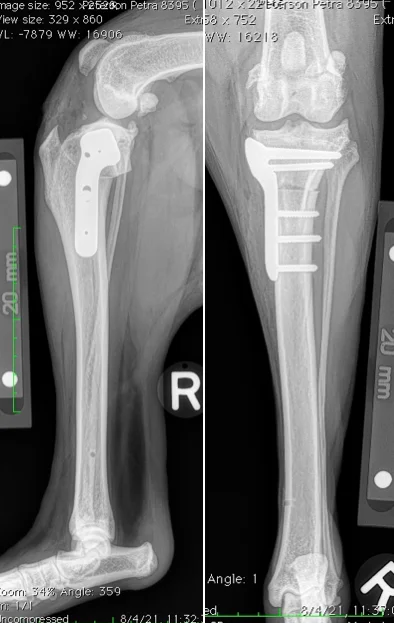
A nice example - based on joint geometry, position and orientation of the osteotomy - of a TPLO stabilized with an Arthrex Vet Systems locking bone plate and screws.
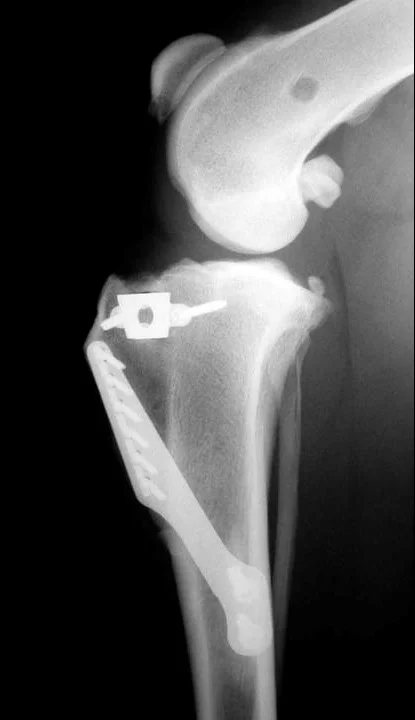
This is an example of a technically sound TTA and utilizes the orginal Kyon cage and fork design implants. Some clinical success has been reported with TTA management of CrCL tearsbut make no mistake... TTA is an invasive, bone-cutting operation that requires the use of metallic orthopedic implants.
Get Informed
Schedule a Consultation
Make no mistake, all surgical procedures are serious. Get the information you need and know your options. Then make an informed decision. Like any service, not all veterinary services are equal. Call to schedule or ask questions.