

Map

Overview
Cranial cruciate ligament (CrCL) insufficiency is the most common acquired orthopedic condition in dogs. It can look very different depending on its form and severity - including the presence of common, secondary meniscus cartilage tears.
ACL is the familar term in humans. In dogs it’s called the CrCL (Cranial Cruciate Ligament).

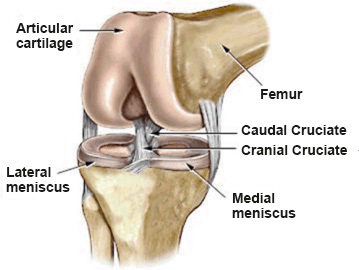
In humans, ACL tears are typically a result of high energy, high impact and sport-related trauma. It's important to know that the vast majority of CrCL "disease" in dogs stems from chronic degeneration and not a singular trauma.
Left unmanaged, CrCL insufficiencies can cause chronic joint pain. A partial CrCL rupture will generally progress to a full tear within weeks or months, and contrary to certain opinion, they do not heal. And because this condition is a degenerative disease in dogs, those that have ruptured their CrCL may have up to a 60-70 percent likelihood of tearing the ligament in the opposite hind limb. Long term complications include increased cartilage damage and chronic, progressive osteoarthritis.
Surgical techniques should involve complete evaluation of the joint, debridement of damaged or diseased CrCL tissue and partial meniscectomy/release as required, either by way of arthroscopy or, less preferably, arthrotomy for comprehensive surgical management of CrCL disease.
CrCL Tear

Anatomy & Function
What does it do?
The knee - or stifle - joint of the dog relies upon soft tissue structures for stability and integrity. Along with the CrCL, other major soft tissue structures stabilizing the stifle are the caudal cruciate ligament and the meniscal cartilages, all of which are intra-articular (within the the joint), and the medial and lateral collateral… Click here to read more.

Treatment
Management of the CrCL tear in dogs can be medical or surgical. In fact, we believe all dogs - at least for a short period of time - require early medical management to reduce knee swelling including activity restrictions, local cold therapy to the affected knee and anti-inflammatory medications. Other approaches… Click here to read more.

CrCL Tears
What is a CrCL? The cranial cruciate ligament (CrCL) is one of the structures connecting the femur (thigh bone) to the tibia (shin bone). An intact CrCL stabilizes your dog's knee during weight-bearing activity, limits hyperextension, and prevents the tibia from internal rotation and cranial thrust (tibia shifting forward). Click here to read more.

TPLO - Learn More
The tibial plateau leveling osteotomy (TPLO) was among the first osteotomy (bone cutting) techniques for the treatment of CrCL tears in dogs. Veterinarians have used it in practice for over 35 years, with nearly 200 research articles published on the topic. Most board-certified specialists consider TPLO the "gold standard" for managing CrCL tears in… Click here to read more.

TPLO - Fast Facts
Do the surgeons at ACOSM understand what I want for my dog?
Absolutely. We know what you want because we've helped thousands of dogs and dedicated pet parents just like you. You're eager to see the glimmer in your furry best friend's eyes when they're able to jump, play and run again. You want them to live their best life because when your dog is happy,… Click here to read more.
Do your research.
Then decide.
We’ll help you understand exactly what is going on with your pet. If you’d like to do your own research, read on. Learn about your dog’s anatomy and how we identify exactly what is wrong and all options for treatment.
We strive for full transparency and to provide all of the information you need to make an educated decision. Note: this information gets pretty technical. Have a question? Let us know. Click here.

"Two other places told me amputation was Fitch’s only option. You disagreed and fixed his leg. You’re basically a Superhero!"
– Bill and Sue T.
Anthem, AZ
Get Informed
Schedule a Consultation
Make no mistake, all surgical procedures are serious. Get the information you need and know your options. Then make an informed decision. Like any service, not all veterinary services are equal. Call to schedule or ask questions.