

Map

Femoral Head and Neck Excision Arthroplasty (FHO/FHNE)
FNHE, or Femoral Head Ostectomy (FHO) is a relatively simple technique involving surgical removal of the ball portion of the hip to alleviate bone-on-bone contact in the diseased joint. With FHNE/FHO, there's a trade-off between pain relief and dysfunctional hip mechanics. Removing the diseased femoral head means there's no longer a ball and socket joint, so the limb cannot function as a natural, normal hip does. Most reports of FHO outcomes are anecdotal. Objective reporting of FHO based on ground reaction force suggests only about one out of three dogs may return to good weight bearing function.
In general, small, lightweight, and high-energy dogs with better muscle mass will have better outcomes with FHO. The advantages of FHO include wide availability, less surgical risk, shorter procedure times, few intraoperative and postoperative complications and lower costs of care.
A commonly asked question is, "If a dog has an FHO and doesn't recover well, can a surgeon do a total hip replacement (THR)?"
We can sometimes convert an FHO into a THR, but it's technically demanding and comes with a higher complication rate compared to dogs that get THR as their primary procedure. The longer the interval from the FHO to a revision, the more complex the total hip replacement becomes. The best results occur when the THR is performed early after the FHO.
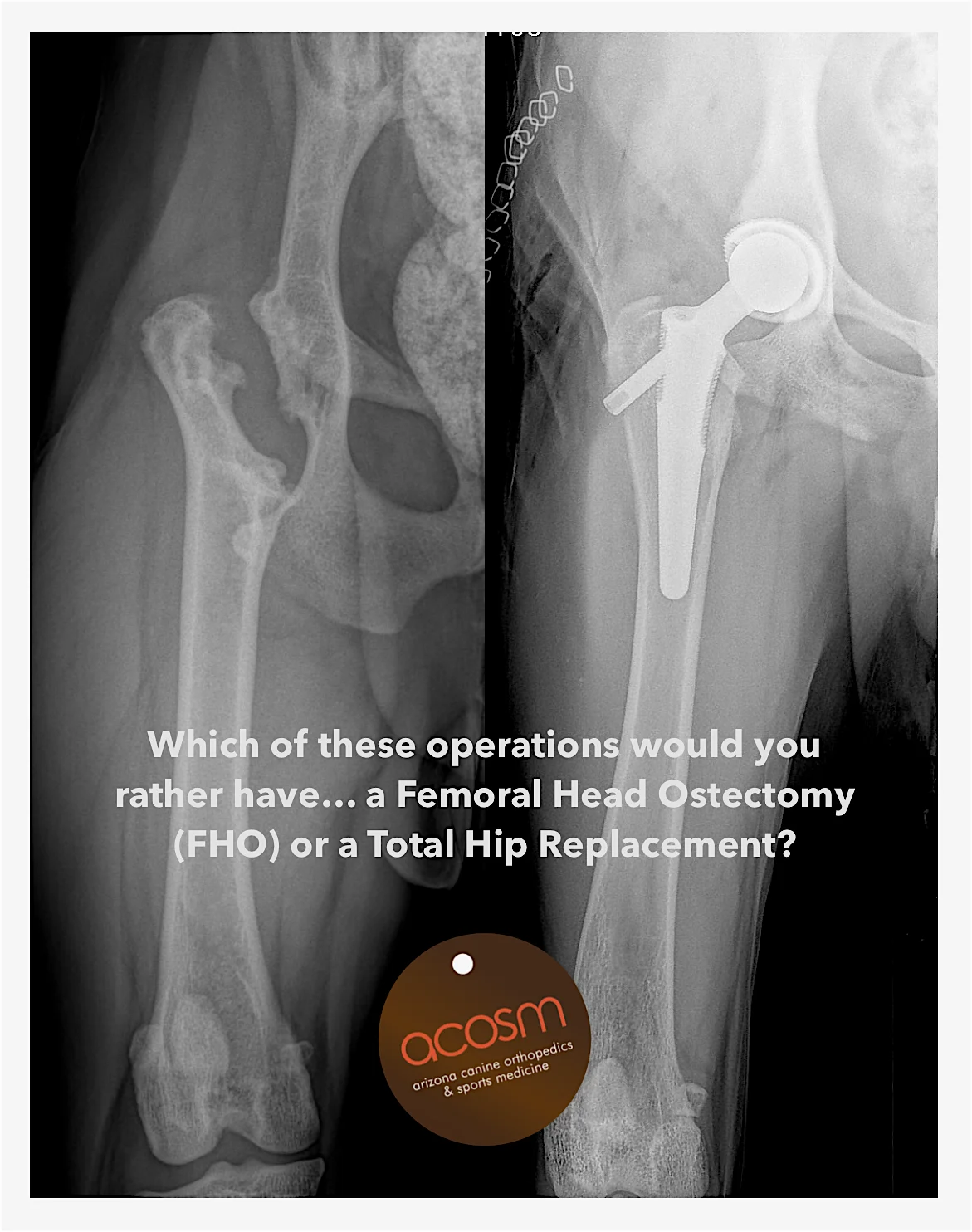
Which of these operations would you rather have... a Femoral Head Ostectomy (FHO) or a Total Hip Replacement?
Get Informed
Schedule a Consultation
Make no mistake, all surgical procedures are serious. Get the information you need and know your options. Then make an informed decision. Like any service, not all veterinary services are equal. Call to schedule or ask questions.